

Last week, I talked a little bit about several times during our lifespan, called critical periods, where we are particularly sensitive to input from our environment. Input like light and eye muscle input to the eyes when we are developing our depth perception in early childhood. Input like hormones and other signal chemicals coming from our placenta to the fetus while developing in the womb (in utero exposure), like the impact of the Dutch hunger winter during the Nazi embargo of food transport in Amsterdam during WWII.
These sensitive times during our development (in utero, infancy/childhood, adolescence) are times of carefully orchestrated growth and changes to organs, brains and hormone regulation. If we are exposed to manmade chemicals that can interact with those systems during those developmental windows, the impacts can be far-reaching even into adulthood and our later years. Because the chemicals interfere with proper hormone function, this is called Endocrine Disruption.
So, here’s the idea. If a developing fetus or child is exposed to a pesticide that can interact with a hormone system that’s orchestrating development, that development is altered in a way that might lead to childhood/adolescence issues like learning disabilities or reproductive hormone changes that impact later fertility, or even the onset of chronic conditions of metabolism like Type 2 diabetes, obesity, thyroid dysfunction, and even cancer in adulthood. There’s also growing concern that early exposure to chemicals, as well as ongoing exposure to chemicals, like pesticides, can contribute to neurodegenerative diseases like Parkinson’s and Alzheimer’s. Called the Developmental Origins of Health and Disease hypothesis– there’s growing evidence to support it. Here’s a diagram from a recent article:
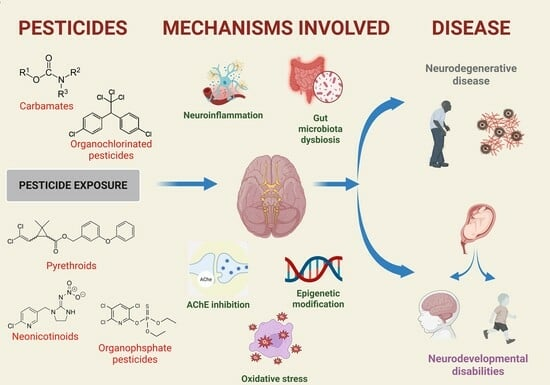
Let’s focus today on what can happen if a fetus is exposed to pesticides during brain development and consider a recent scientific article by Salma Mowafi and colleagues at the American University in Cairo, Egypt that evaluated evidence showing links between pesticide exposure and neurodevelopmental problems in kids. It was a global review of the links between pesticide exposure and neurodevelopmental disorders.
How are fetuses exposed to pesticides during pregnancy?
The placenta is a phenomenal organ that regulates what goes into and out of the fetus’ circulation. The nutrition comes from the mother’s blood stream- vitamins, sugars, protein, fat. Other key chemicals, too, like hormones, blood products like immune system molecules, and a whole lot more are critical to the growing baby. A lot of the manmade chemical pesticides (and all the chemicals packaged with them) can also get into the baby’s blood supply from the mother’s blood. The mother gets the pesticide mixtures in her blood by breathing them in, by drinking water that’s contaminated, by eating healthy food that has pesticide residues, by skin contact through lotions (like insect repellants).
What kinds of effects do these pesticide mixtures have? Here’s just a few. Honestly, if I listed them all, you’d get really scared.
- There’s a very convincing body of evidence linking exposure to DDT during pregnancy to childhood developmental issues like cleft palate, neural tube defects, low birth weight…. Even though DDT was banned in the US in the 1970’s, it’s basically a “forever” chemical and is still found in our food and water because DDT is not banned all over the world. It is still used in countries to combat malaria outbreaks, for example. But, for most of us in the US, DDT is not a major contributor to childhood developmental issues anymore (whew!).
- Chlorpyrifos is a major insecticide used in agriculture in the US. Exposure to chlorpyrifos (by simply living about a mile from an industrial agricultural farm) during pregnancy, especially during the second trimester means a higher risk of autism for the child.
- Chronic exposure to low levels of organophosphate pesticides in the prenatal period is associated with greater likelihood of ADHD. These pesticides include chlorpyrifos, malathion, glyphosate, and diazinon, and many others.
- Prenatal exposure to pyrethroid insecticides is also associated with increased risk for ASD (Autism Spectrum Disorders), developmental delays and learning disorders. Yikes. Pyrethroids are very common, both in agriculture and for home/garden use.
- Several studies published over the past three years have shown links between prenatal exposure to organophosphate pesticides (like chlorpyrifos and glyphosate) and pyrethroids and neural tube defects (like spina bifida) and movement disorders in the children.


The bottom line with this review study, as well as many others, is that exposure to many different types of pesticides during pregnancy can lead to cognitive, behavioral and many other brain-related problems in the children.
Types of exposure
Since even very low levels of pesticides can alter development, we need to be aware of how these exposures happen, to pregnant mothers and to babies and kids. Living near agricultural operations is a big route of exposure. Living near a golf course is a big route of exposure. So is having the chemicals applied to lawns in the neighborhood, playgrounds, school yards. Pesticide residues in drinking water and baby food. Of course, not all people are equally exposed to pesticides. Folks who live in rural, agricultural communities are at highest risk and many of these individuals are from lower socioeconomic status or minority communities. Living near pesticide chemical factories is also a very high risk, which also tend to be located near poorer communities.

Increasingly, though, medical professionals are finding these neurodevelopmental conditions, as well as conditions like asthma or reproductive development issues, in more affluent, suburban communities. Pesticide residues in the household dust, in the air in suburban neighborhoods, are correlated with these conditions, as well as childhood leukemia. More affluent households also have greater access to fruit and vegetables year-round imported from abroad, where pesticides are not regulated or where regulations are not enforced. Many of these households have regular, full-service lawn care that regularly applies synthetic pesticides. Most of the research has focused on agricultural regions, so a lot more work is needed to understand more fully how lawns contribute to illness and disability.
Coming Back to Haunt in Later Life
Even if pesticide exposures during pregnancy, infancy, childhood and adolescence don’t result in obvious neurodevelopmental or medical issues (like asthma), the impact of those early life exposures might emerge later in life in the form of Type 2 diabetes, obesity, Alzheimer’s disease, Parkinson’s disease and cancers like Non-Hodgkins lymphoma or thyroid cancer.
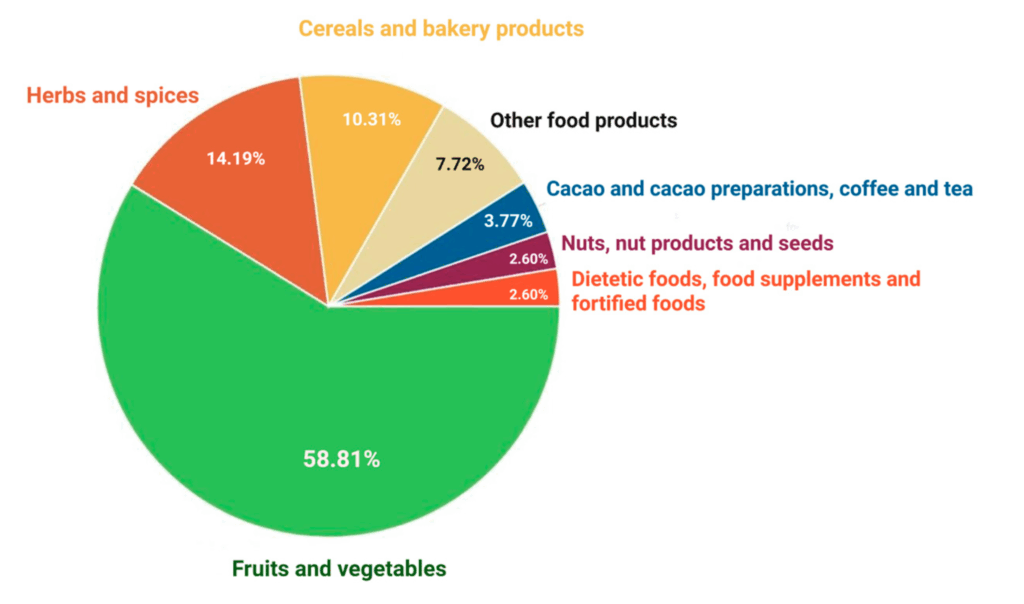
In a paper published just this past summer, scientists from Romania led by Alexandra Andreea Botnaru compiled the mass of evidence detailed in the Rapid Alert System for Food and Feed (RASFF), a European national food safety authority that tracks pesticide residues in food. This diagram shows the distribution of pesticides across different food categories:
Repeated exposures in adulthood to pesticides like chlorpyrifos and glyphosate have been linked to higher risk of Parkinson’s and Alzheimer’s diseases later in life. Prenatal exposure to these (and other) pesticides, many of which cross the placenta, increases the risk of childhood acute lymphoblastic leukemia. It turns out that exposure to indoor pesticide residues from household insecticides in early childhood also increases the risk for lymphoma later in childhood. A study in LA showed a link between parental exposure to pesticides used for ticks and fleas and brain tumors in their children.
Evidence collected by the “Child Health and Development Studies” highlighted an increased rate of breast cancer in adult women exposed to DDT while they were fetuses. These women, whose mothers were exposed to DDT while they were pregnant, had a 5-fold higher risk of breast cancer. Children of mothers exposed to DDT while pregnant also had higher rates of cervical cancer, uterine cancer and skin cancer. DDT was banned in the US in the 1970’s. The mothers were exposed, let’s say, in the 1960’s. Their kids, now in their 60’s and 70’s, are showing up with cancers.
Meanwhile, since the 1990’s, there have been hundreds of potent pesticides, as well as burgeoning use in agriculture and lawn care. Kids from pregnancies in the 1990’s are now entering their 30’s….it’s kind of sobering to wait to see what will happen as a result of our much expanded exposure to pesticides nowadays (as compared to the 1970’s). Stay tuned!
Sources:
Salma Mowafi, Agreeg Dabbish, Chisom Chukwuma, Lobna Adel and Anwar Abdelnaser. 2025 Toxic sprays, fragile brains: Assessing pesticides exposure and disparities on neurodevelopment. Neuroscience 579: 344. https://doi.org/10.1016/j.neuroscience.2025.06.021
Alexandra Botnaru, Ancuta Lupu, Paula Morariu, et al. 2025. Neurotoxic effects of pesticides: Implications for neurodegenerative and neurobehavioral disorders. Journal of Xenobiotics 15: 83. https://doi.org/10.3390/jox15030083
Heloiza Nicolella and Sonia de Assis. 2022. Epigenetic inheritance: Intergenerational effects of pesticides and other endocrine disruptors on cancer development. International Journal of Molecular Sciences. 23:4671. https://doi.org/10.3390/ijms23094671
This newsletter is devoted to explaining how biology works and how it is relevant to our daily lives. Most of us stopped learning about biology in high school or even middle school. And the way we learned it was as isolated concepts and vocabulary to memorize. I hope that this newsletter helps you rekindle that love of biology and might even help with better understanding of some of the important biology all around us. Please share this with anyone you think might want to take a look.
Thanks for reading!