
Managing all the things that go bump! In the brain.
A Post by Claire McHarg
For some, it starts with an aura, for others, vertigo, but anyone who suffers from any form of migraine knows once the tells start, they’re in for a rough ride.
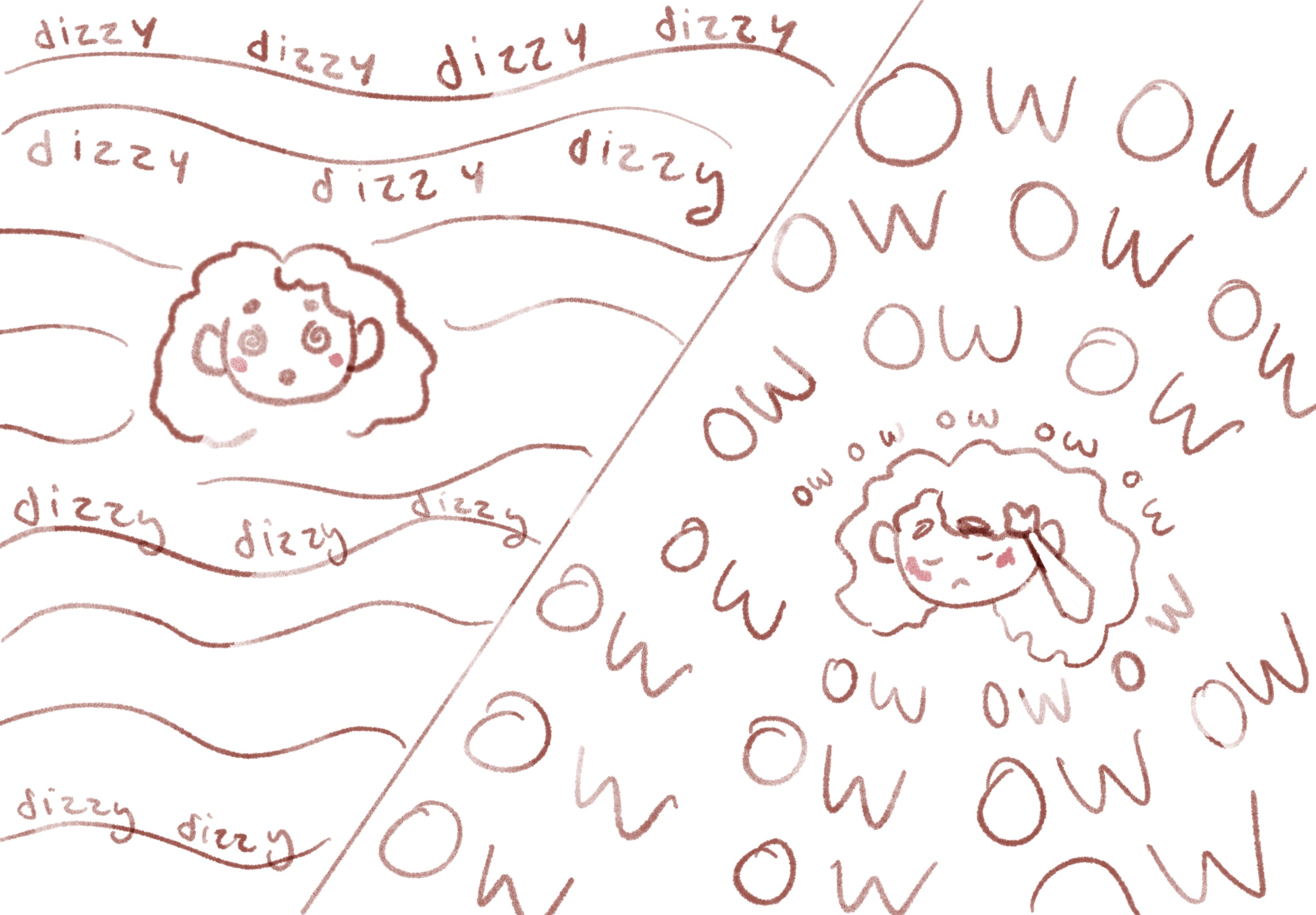
My parents both agree that when I was a toddler, when sat on the kitchen counter, I would sometimes grab the edge as though I were falling, despite having not moved at all. I called them the “tippies.” The funny thing about all this is that my child neurologist of a father did not think to mention the tippies again until I was a freshman in college expressing that I was experiencing dizzy spells that would send the world spinning while just sitting in a chair. My dizziness was disorienting episodes were scary and entirely unpredictable. It seems that I have likely suffered from vestibular migraines my entire life, which is an important distinction.
But wait, just dizziness? Where’s the headache? When people think of migraines they jump to the concept of the debilitating, day-long headache. Its official diagnostic criteria say that you experience long-term pain (4-72 hours), at least two of the following qualities (one-sided pain, pulsating pain, moderate or severe pain intensity, or aggravation by movement), and potentially at least one non-headache symptoms (nausea, or light-sensitivity). The trigger factors range from hormones to changes in the weather, and knowing your specific triggers for an episode can be crucial. It’s the frequency of these headaches that define the condition’s severity. Patients with 15 or fewer monthly migraine days (MMDs) or monthly headache days (MHDs) are classed with “episodic migraines, while more than 15 days (at least 8 of which must be MMDs) of headaches are classed into “chronic migraines”. Considering that while days with headaches could elapse a quarter to half a month, it’s no wonder that some migraine sufferers count “good days” more than bad ones if their condition is extreme enough.
The International Classification of Headache Disorders (the ICDH-3, with its above diagnostic criteria) does not include my symptoms except in an appendix for research purposes (as of 2021). A quick internet hunt for migraine symptoms usually describes something much more serious than what I’m used to experiencing. I get a handful of headaches a month, usually light sensitive, and paired with some sort of vertigo, but with one dose of ibuprofen later and I’m back to class. How can I consider migraine headaches a viable diagnosis for me, if I wanted to bring it up to a medical professional, for instance?
The first step would be finding a doctor. I’m lucky to know a neurologist since I’m related to one, but he can’t treat me, so he’d recommend someone else in his hospital network or another practice he knows and trusts. What if I had to start from the ground up, where would I begin? Finding a doctor is only the first step, the next is finding one you like who will actually treat you. Many people have struggled to get doctors to believe them, but some find doctors more frustrating than others.
When it comes to migraines, white women get diagnosed more than any other demographic group. Studies show that there are no sex-related differences in the frequency of migraine attacks, even if women who experience migraines are more likely to receive medical attention for their condition than their male counterparts. More notably, as with much of medicine, there is a distinct racial bias that prevents patients of color from getting an accurate diagnosis. A Harvard study concluded that “in the US is roughly equivalent, African American and Hispanic patients are, respectively, 25% and 50% less likely to be diagnosed with migraine compared to white patients”. On the anecdotal level, the American healthcare system is notorious for not treating certain patients, and the studies from influential institutions properly reinforce our suspicion that something is wrong.
When doctors get to choose whose symptoms are worth paying attention to versus which ones can be ignored, innate bias can leave people undiagnosed and suffering. Does this mean doctors are entirely useless? Of course not, but if patient well-being unintentionally slips through the gaps of the healthcare system due to doctor negligence, how do patients advocate for themselves when the authorities don’t list them? The focus of healthcare should always be on the patient. While that feels entirely obvious, anyone who has ever fought through the American Healthcare system and its partner insurance systems knows it’s more complicated than that. Premiums on health insurance plans are reaching all-time highs
Imagine a world where anyone who gets a concerning amount of headaches can go to a doctor and someone will take the time to listen to the whole story. Where there is no dismissal because of how healthy your doctor perceives you to be. This utopia starts with all of us, who are all patients, understanding that we are not helpless creatures waiting for doctors to understand our intricacies. While we might not all be experts or have one easily on call, we can start by talking to each other. Having a community of resources to help navigate a complex system could be essential to finding that right doctor, or avoiding the ones that won’t believe you.
References
Allais, G., Chiarle, G., Sinigaglia, S., Airola, G., Schiapparelli, P., & Benedetto, C. (2020). Gender-related differences in migraine. Neurological Sciences, 41(Suppl 2), 429–436. https://doi.org/10.1007/s10072-020-04643-8
Lempert, T., Olesen, J., Furman, J., Waterston, J., Seemungal, B., Carey, J., Bisdorff, A., Versino, M., Evers, S., Kheradmand, A., & Newman-Toker, D. (n.d.). Vestibular migraine: Diagnostic criteria (Update)1. Journal of Vestibular Research, 32(1), 1–6. https://doi.org/10.3233/VES-201644
MD, P. R. (2022, February 15). Health disparities and headache treatment. Harvard Health. https://www.health.harvard.edu/blog/health-disparities-and-headache-treatment-202202152685
Migraine vs. Headache: How to Tell the Difference | Penn Medicine. (n.d.). Retrieved February 13, 2024, from https://www.pennmedicine.org/updates/blogs/health-and-wellness/2019/november/migraines-vs-headaches
Nguyen, K. H., Fields, J., Cemballi, A. G., Desai, R., Gopalan, A., Cruz, T., Shah, A., Akom, A., Brown, W., Sarkar, U., & Lyles, C. R. (2021). Illuminating the Role of Community-Based Organizations to Improve Chronic Care for Safety-Net Populations. Journal of the American Board of Family Medicine : JABFM, 34(4), 698–708. https://doi.org/10.3122/jabfm.2021.04.200591
Nicholson, R. A., Rooney, M., Vo, K., O’Laughlin, E., & Gordon, M. (2006). Migraine Care Among Different Ethnicities: Do Disparities Exist? Headache, 46(5), 754–765. https://doi.org/10.1111/j.1526-4610.2006.00453.x
Racial Disparities in Migraine Care. (n.d.). American Migraine Foundation. Retrieved March 20, 2024, from https://americanmigrainefoundation.org/resource-library/racial-disparities-in-migraine-care/