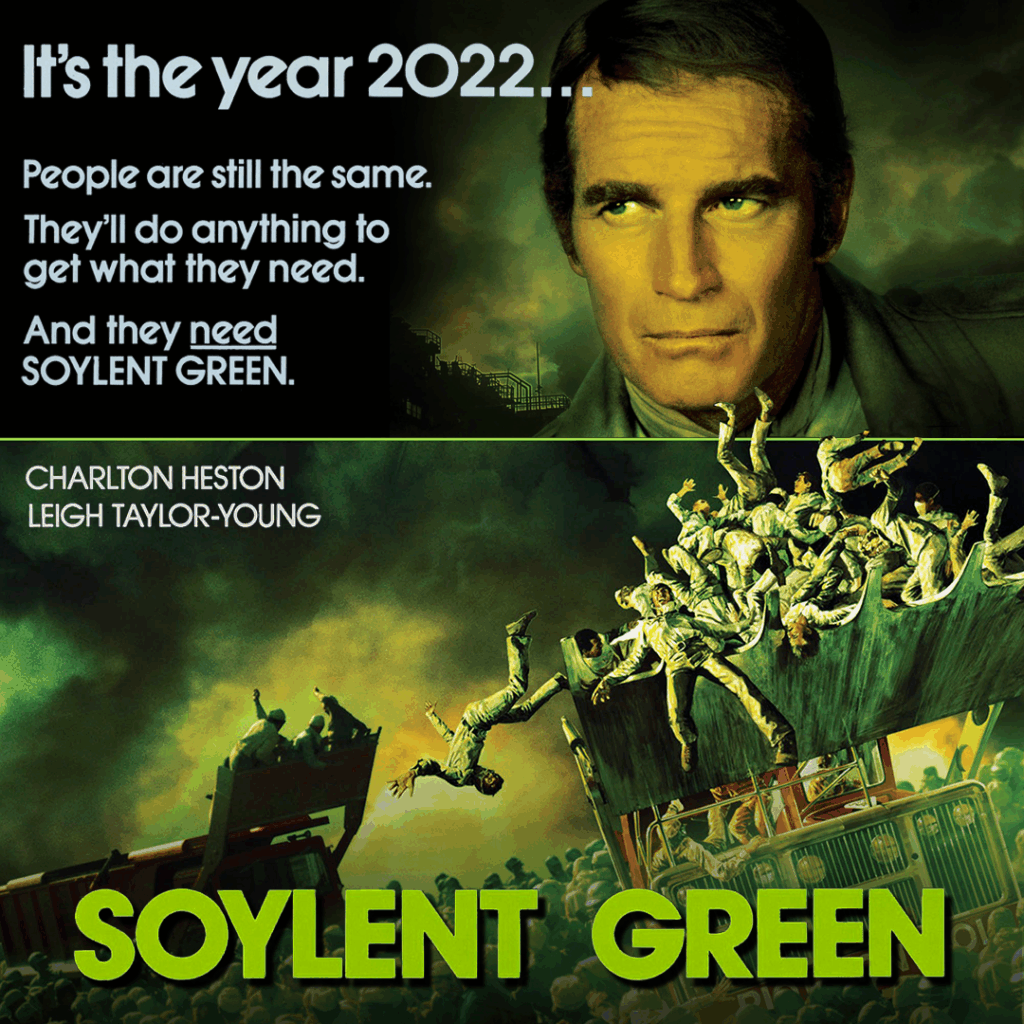
Remember that classic sci-fi climax line, screamed by a thrashing Charlton Heston being hauled off to an insane asylum? In 1973, the year that movie came out, there was a cultural and political focus on the realization that the human population was exploding exponentially. That same year, the Battle for the Planet of the Apes came out. Another dystopian sci-fi flick about the catastrophic demise of humans because of overpopulation and environmental destruction.
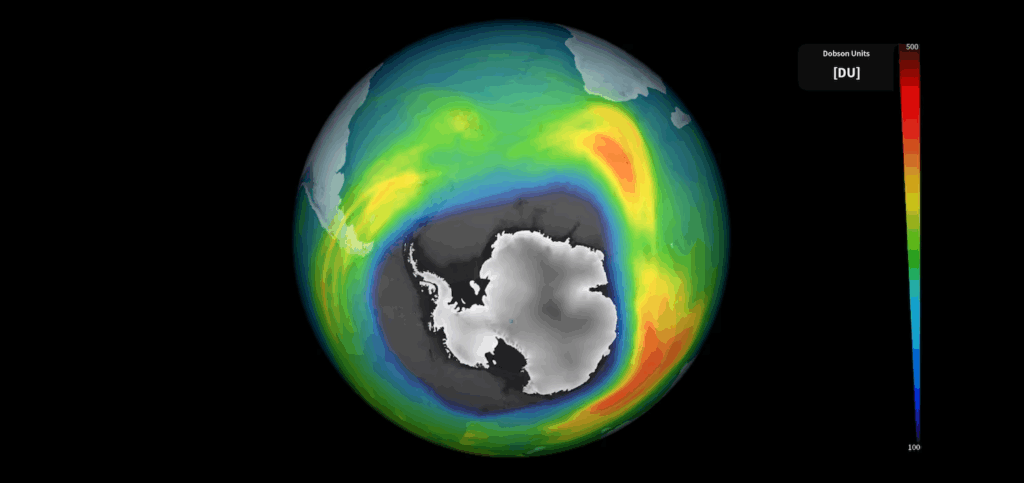
In the 1970’s, Americans were faced with ideas of over-exploitation and resource limits. There was fear that we would not be able to feed the world’s population of people (3.7 billion at the time). Fear that we would run out of fossil fuels and be plunged into a dark world with blackouts and empty gas tanks. In the 1980’s and 1990’s, we added another big fear- that of the hole in the ozone layer of the atmosphere widening because of the release of chlorofluorocarbons (CFCs) from refrigerators. Without an adequate ozone layer, the sun’s UV rays would reach the surface to a much larger degree and cause skin cancer, mutations, plant damage and more. We began to realize that we are all on this tiny planet together, and that there are so many of us that our activities impact the entire globe- the air, the water, the food, the climate.
This newsletter is not about the history or politics of how we’ve gotten to this place in our planetary destruction. But, I do wonder that the time in which I grew up, where we were concerned with human over-population and exceeding the ability of the planet to provide us with the food and other resources we need to survive, has somehow slipped from our national memory. Our global memory, even. Now, countries that had successfully reduced their birthrate are urgently encouraging women to have children. Just this week, a news piece describes a new program in a number of provinces in China where women will be paid the equivalent of $500 for each child, as an incentive to have more children. Let’s unpack population growth a little bit because the sheer numbers of humans on the planet is a key part of our modern world.
Time for a little population biology!
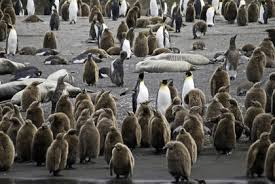
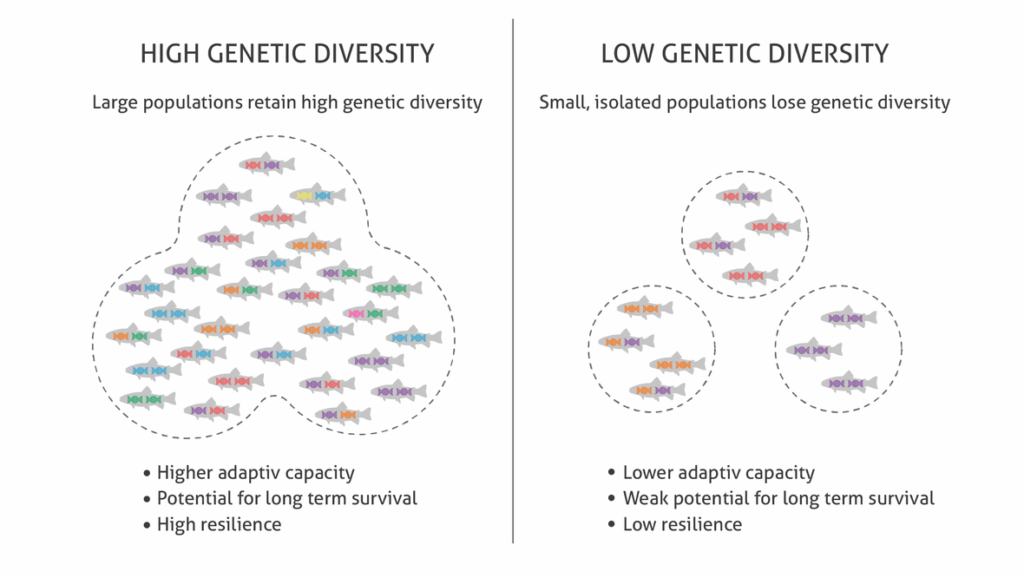
A population is the number of individuals of the same species living at any time in a particular area. Each individual has its own particular combination of traits and, together, the population has a level of genetic diversity through mating (if the organism is a sexually reproducing organism), gene flow like immigration, and mutation rate. Populations need genetic diversity to enable it (the population overall) to withstand challenges like famine or increased temperatures. For example, some individuals might be better able to eat hard seeds (because of tougher beaks or teeth, for example) than others and, if the population’s food supply become dominated by hard seeds, those are the ones whose offspring survive. Populations that get too small have less genetic diversity, so are vulnerable to being wiped out because they cannot survive sudden environmental change. That’s one big reason why biologists are worried about the huge declines in animal and plant populations from pesticide use and deforestation, for example. If all the populations of a species get too low, the species is at risk of extinction.
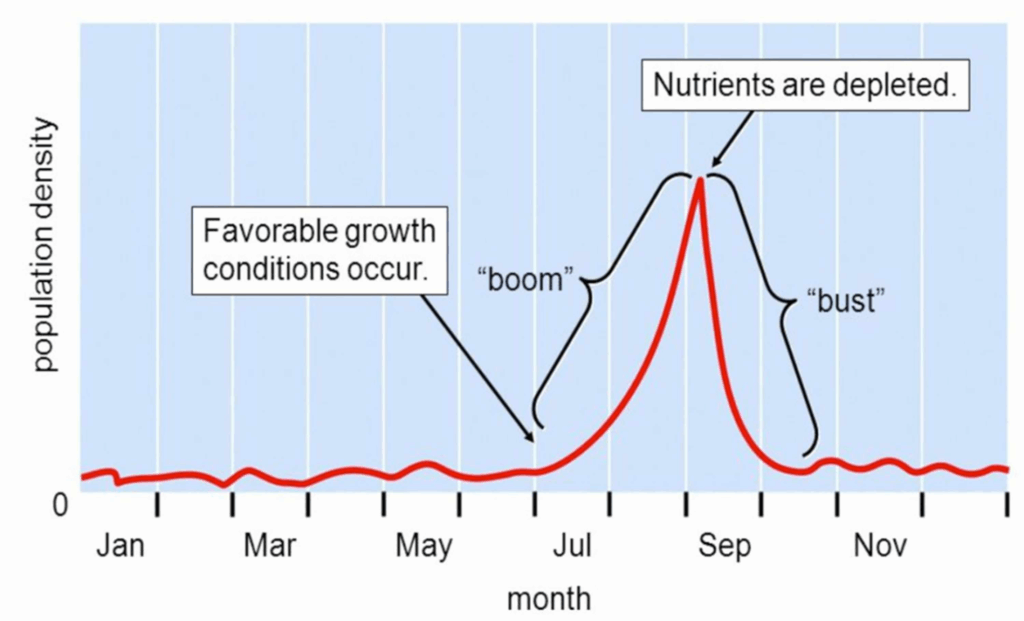
A population’s size is increased through births or immigration from other populations of the same organism. A population’s size decreases as a result of deaths (from predation or disease) or emigration, where deaths/emigration exceed births/immigration. If a population gets too big, the environment might not have sufficient food, water or shelter and the numbers will fall because of increased deaths or emigration or decreased births. Some organism populations go through regular “boom and bust” cycles, never really being at a stable, sustainable level. Others seem more stable and balanced where the births/immigration is balanced by the deaths/emigration. Stability of population size also depends on things like predators or natural disasters like floods, and the other organisms that are part of the overall ecosystem where that population lives. For example, if the insect populations in an area are plummeting, then the birds and others that depend on those insects for food will also suffer population decline.
How are human populations different?
The same principles are at play with humans, although some argue that human technology keeps inventing ways to provide enough food and resources for human populations to just keep on expanding. During the industrial revolution, humans developed technology that enabled us to set up populations all over the planet, to mass produce food in wealthier areas, and overcome many diseases with medical advances. There were just over a billion people on Earth in 1800, 3.7 billion in 1970 and now, in 2025, there are over 8 billion people. The rate of that population growth was at it’s highest rate in 1963 and is now a slower rate of growth of 0.85%, but it’s still growing. Here’s what that looks like on a graph:
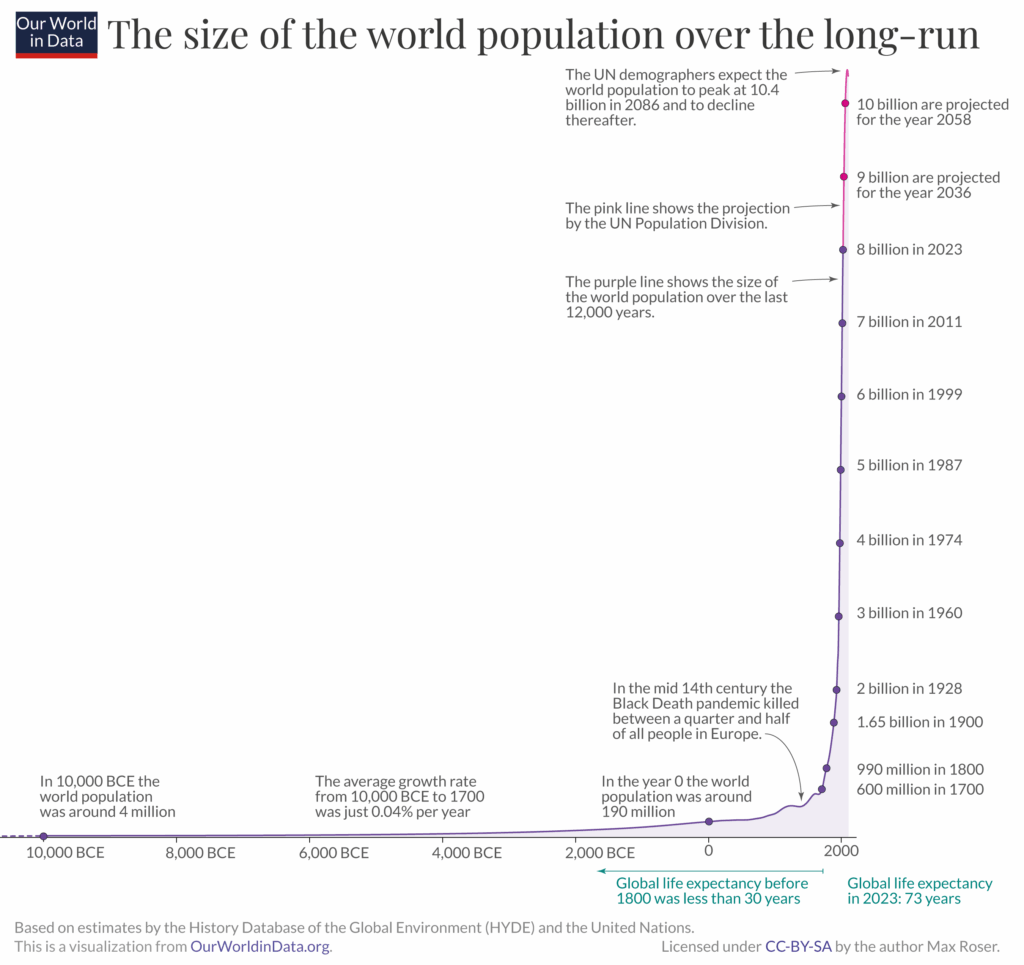
As you can see, humans are in NO DANGER of population decline. What we’ve been seeing is a fall in the rate of increase. Here’s what our population growth looks like if we just take the numbers from 1800-2025- that very steep incline from about 1 billion to our current over 8 billion:
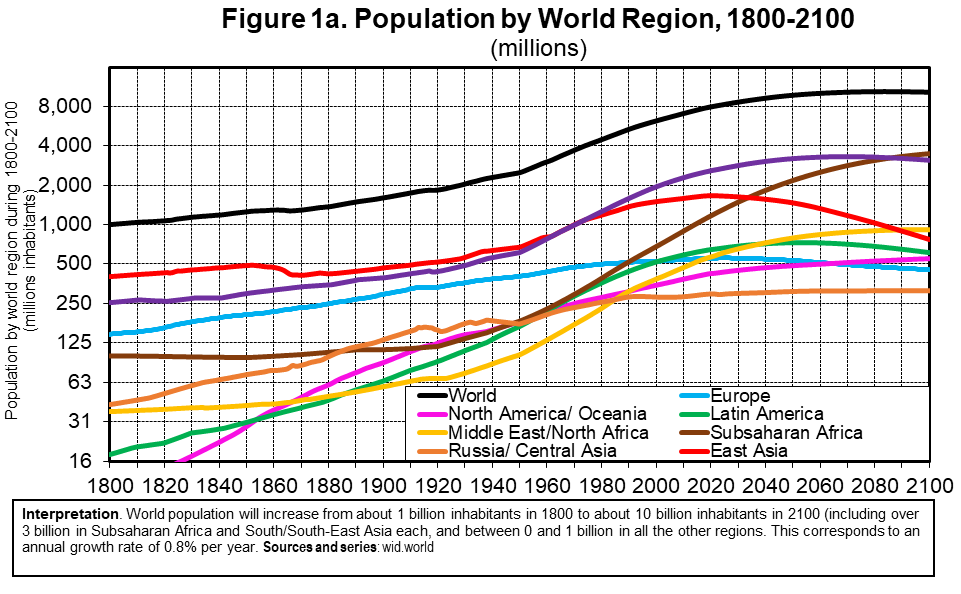
This expanded curve makes it look like a slower increase, but it’s still exponential. If you look at the red curve, for East Asia, you’ll see a decrease in the rate of increase in population size from 1970 to almost no increase around 2020. That reflects the one-child policy in China, with a big decrease in birth rate, along with a death rate that was not changed from before. The fall off in population numbers for East Asia after 2040 is a prediction if there’s no change in the birth/immigration and the larger, older, population from before the one-child policy begin to die. With China now encouraging more births, that prediction may not hold up.
During the same interval, the rate of increase in SubSaharan Africa went way up beginning in 1950 (look at the dark brownish-purple line in the graph above). There is still a large rate of increase, largely reflecting a birth rate, but also a reduction in deaths as medical improvements and quality of life improvements occur.
Here’s another way to look at it, when looking at that first graph. The human population went from 1 billion (in the year 1800) to 2 billion in 1927 (127 years). Then, it doubled again from 1927 to 4 billion in 1974 (47 years). Then, it doubled again to 8 billion in 2022 (48 years). Population addition from births still EXCEEDS losses from deaths, even as the birth rates have fallen. At the current rate of increase, we’ll reach 9 billion humans in less than 15 years (9.8 billion by 2050), and reach 10.2 billion by 2100. Here’s a short and helpful article published earlier this month about predictions about population growth as we approach 2100. The last thing we should do is encourage human populations to increase the birth rates again!
As the global human population continues to grow without restriction, we will continue converting forests and even oceans to farmland and habitations. We continue to over-harvest timber. We continue to spew carbon dioxide and many other chemical contaminants into the air, soil and water. We continue to crowd out, poison and exterminate other creatures. It seems logical that our unfettered and destructive growth must have a limit.
Many scientists see evidence that we’ve hit the limits of how much Earth can handle with the reality of climate change and other human impacts. Only about 19% of the Earth’s land is considered “wild”, but pretty much every inch of the planet is affected by humans. There are limits to how much the Earth can handle of the mountains of plastic everywhere from the garbage patch in the Pacific to the microplastics in our own bodies. As climate change and environmental poisonings make it harder for us to survive, our various populations begin to vie for what’s left. We see huge human migrations to cooler regions, or less polluted regions. We see violence and conflict over resources that we need to maintain our way of life. These kinds of conflicts have been increasing as the degradation of Earth has continued.
So, why are some countries claiming a population crisis and paying people to have more children? The issue of human population demographics (the number of youth, the number of elderly, the number of working age adults in a country) has to do with economic worries about aging folks outnumbering workers. The concern also has to do with tribalism– a cultural value that rejects immigration as a way to increase workers or change a country’s population demographic.
Population Demographics Over Time
The Picture in the US
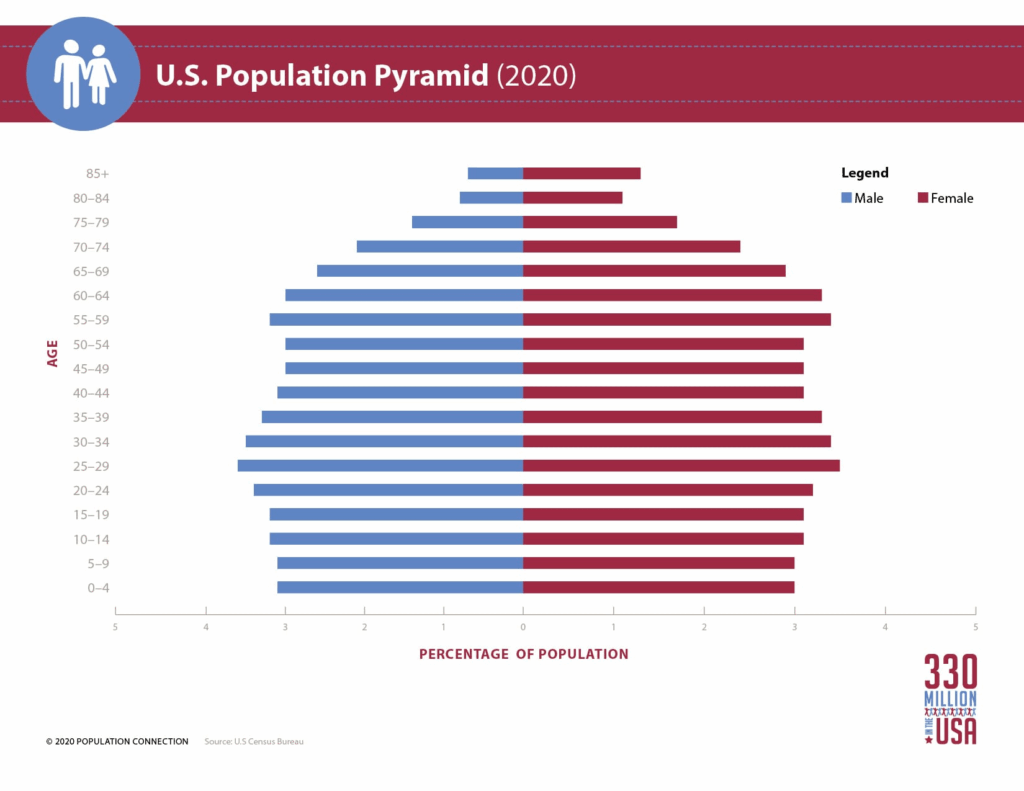
The chart above, from 2020, is of the overall US population’s age structure. You see that it’s, overall, pretty columnar for the age ranges of folks in their 20’s through their 40’s. These are people who are of child-bearing age and are wage-earners. A pretty healthy age distribution, where the working adults can support the older folks and the young. The concern is what will happen when those smaller groups of young folks become the workers, trying to support a larger aged population, which is one reason for all the doom and gloom about social security benefits running out. One way to address this could also be immigration from places in the world where survival is challenging. But, the current state of tribalism in the US complicates things quite a bit.
The Picture in China
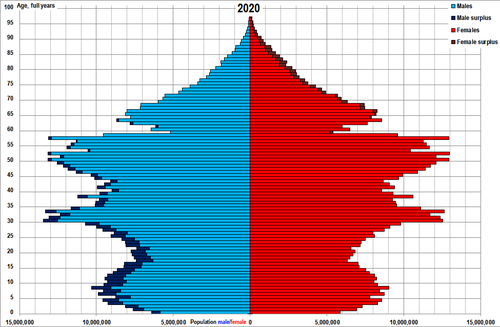
This next one is China’s demographic profile from 2020 (source: Wikipedia). Right now the workers are the largest group (like in the US). You can see the effect of China’s one-child policy that ran from 1979 (folks currently in their 40’s and younger) to 2015. The Chinese government is concerned that, as the current workers age and then dominate the older age brackets, the number of younger workers is lower than the number of older adults, meaning fewer workers to support a larger group of older folks. But, that’s a necessary stage for a population to go through, in order to achieve, ultimately (in 80 years or so), a stable population that’s manageable. That was China’s goal back 40 years ago. Unfortunately, China is freaking out and reversing course, rather than waiting it out.
Some country’s leaders are calling for more children, in an effort to yield a demographic where, in 20 years, the worker group again dominates. But, this is not a good idea at all. And, other countries are still exhibiting a greater- than-replacement birth rate. That’s where several countries in central Africa are right now:
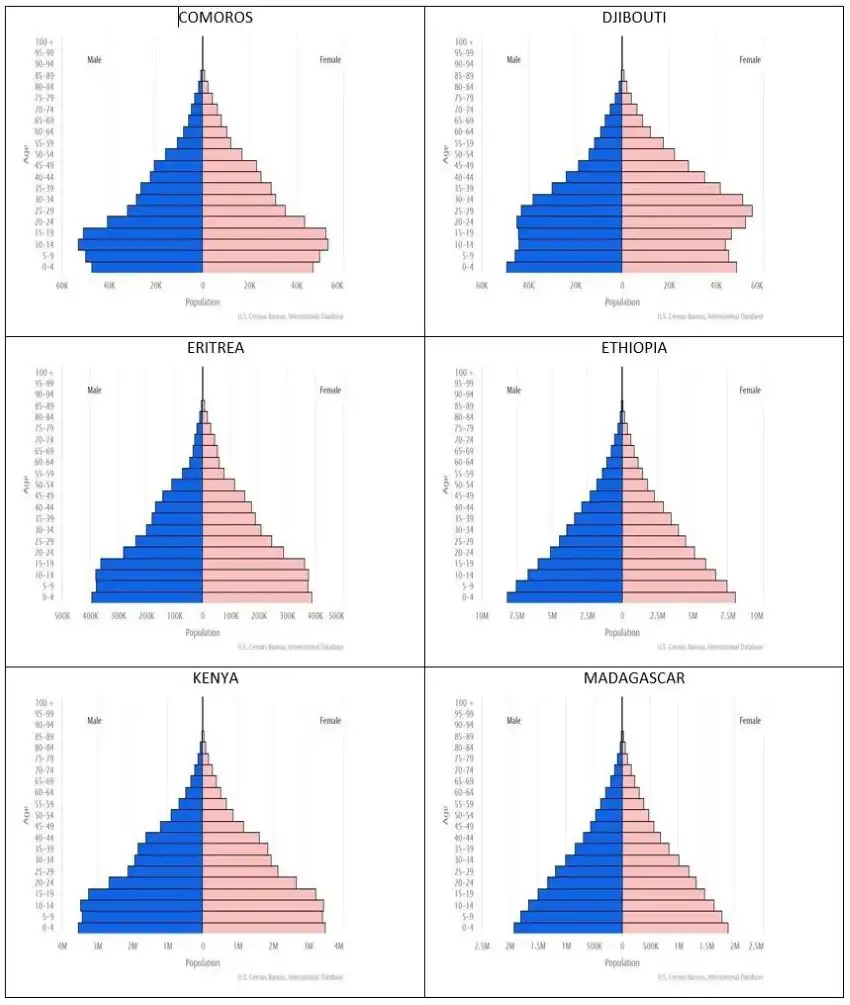
These graphs show the larger population growth rates, evidenced by children as the largest demographic category. Currently, it’s difficult for the workers to provide enough for the young groups. If this large birth rate continues, the overall population will surge, putting a strain on the resources available for the population.
In our current human world, we still think of ourselves as different tribes and races, rather than that we are all humans. From the perspective of planet Earth, though, we are all the same species and there are way too many of us. With human populations all over the globe and with global trade and resource distribution, it’s better to think about the whole human population and the ability of Earth to meet its needs, rather than the needs of individual countries of people. And, from that perspective, with the massive loss of biodiversity, the deterioration of tremendous swaths of land and sea, the growing regions that are too hot or too dry to support human life, and the acceleration of both frequency and intensity of disastrous events like floods and fires, we do have more humans than Mother Earth can sustain.
What dawned on us in the 1970’s is our reality today.
This newsletter is devoted to explaining how biology works and how it is relevant to our daily lives. Most of us stopped learning about biology in high school or even middle school. And the way we learned it was as isolated concepts and vocabulary to memorize. I hope that this newsletter helps you rekindle that love of biology and might even help with better understanding of some of the important biology all around us. Please share this with anyone you think might want to take a look.
Thanks for reading!