
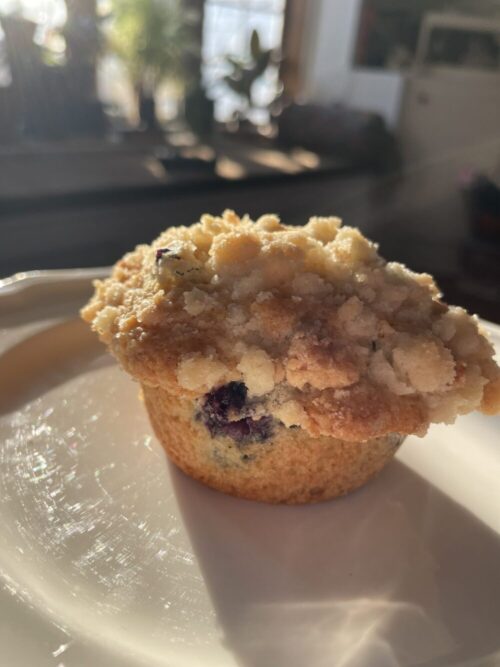
Most of us think that we taste with our tongues. We can detect five categories of taste: sweet, salty, sour, bitter and umami (meatiness). Right? Well…..
There’s a whole lot more to taste than is on the tongue! You could say that most of us only know the “tip” of taste.
Let’s dip into taste.
Think about popping a bite of your favorite dessert into your mouth. Maybe a fork of cheesecake, or a spoon of ice cream, or a Reese’s peanut butter cup. Mmmmmm-mmmm.

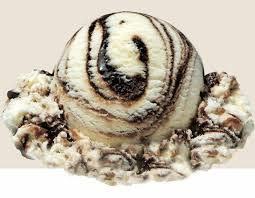

You chew, moving the food around in your mouth. What goes into that burst of flavor that excites your mouth and mind?
There’s the mixture of flavor compounds, dissolved in your saliva into a complex solution that bathes the tastebuds on your tongue. There’s also the sense of the texture of the food- smooth, creamy or crunchy. There’s the smells that reach your nose from airborne chemicals swirling around at the back of your mouth and throat. If you try to describe your sensations, you’ll mention different types of smells and flavors- a hint of salty, caramel, spicy. There’s also the temperature of the food that we detect and experience in our mouths and throats. Think about the taste or flavor of a warm piece of pizza as opposed to a cold slice. Same chemicals, totally different experience. So much more than just five simple taste categories. You even conjour up perhaps an event that you associate with the food- maybe a favorite birthday event, or that restaurant on your vacation. You also might crave something so deeply that you are motivated to go out and get it. Have you ever craved chocolate, or really “needed” some ice cream or something crunchy? And, how wonderful it feels to satisfy the craving!
Lots of incredible neurobiology. Sensations, memories, behaviors, motivations.
Depending on where the sensory receptors are, and where the nerves go, you’ll get different consequences. You perceive a flavor differently if the receptor/nerve cell combination is on your tongue, or in your mouth, or in your nose, or in your throat, or in your airway, or in your stomach, or in your intestine. That’s right- taste is not just about chemicals dissolved in your saliva. Think about what happens when you eat something very spicy. You feel the “burn” down your throat. Your eyes water. You cough. You salivate. You feel a strong motivation to drink water. You might even gag or start to vomit. There’s a lot going on, for sure. Way too much for a single newsletter. Let’s focus on just a simple taste- back to that dessert.
Where a taste starts- the tastebud
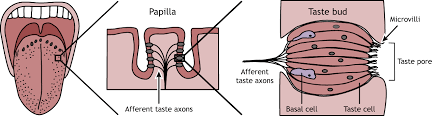
Our tongue is filled with bumps- these are NOT tastebuds. Rather, they are grooves and ridges that increase the surface area for detecting chemicals. The roughness also helps with breaking down food, gripping the paste and moving it to the back of the throat to swallow it. Within the ridges are embedded tastebuds. Taste receptors are also found in the throat, the soft palate at the roof of the mouth, the epiglottis and even parts of the esophagus. Taste receptors have also been found in the small intestine and play a role in the release of insulin in response to the presence of sugar while you digest food.
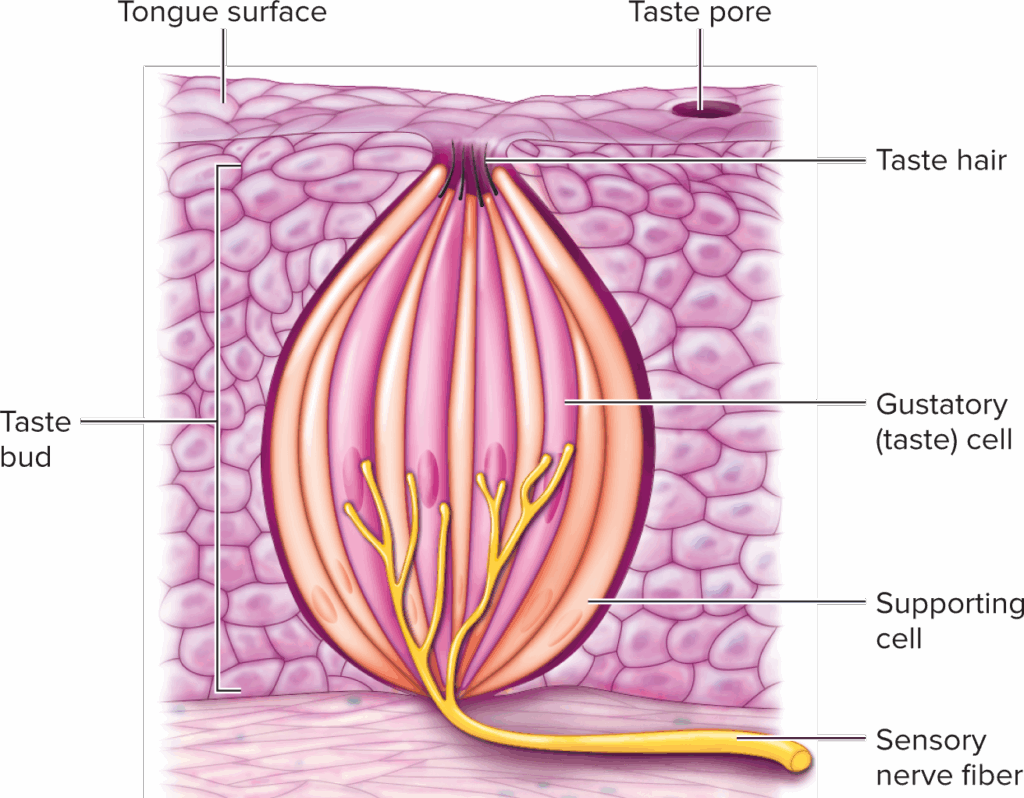
Tastebuds are a small collection of taste receptor cells encased by other cells that provide structural support and also cells that can turn into taste receptors, in a renewal/replacement process that completes every ten days or so. When we put food in our mouth, we chew it, move it around with our tongue and basically form a paste or solution using the saliva that is released from our salivary glands in response to both the presence and the smell of food. Tastants, molecules in the food (sugars, amino acids, salts and more) enter tiny pores in the tastebuds and make contact with receptor proteins on the taste cells. That receptor protein responds to the chemical interaction by setting in motion a series of chemical reactions in the taste cell that leads to it release chemicals, neurotransmitters, that interact with nerve endings of nerve cells. Each taste cell has a specific version of receptor that interacts with only one category of chemical- like sugar, or amino acid, or citric acid (in lemon, for example) or salt. Each tastebud has several taste receptor cells, and so a taste bud can respond to more than one type of tastant.
How we perceive tastes- the brains of it all
Our taste system is really two different systems. One evolved to encourage us to eat food for nourishment. We are more likely to be motivated to eat if we enjoy it- if the food substances reward us for taking the time (exposing us to risk of predators) to stop, put food in our mouths and ingest. That system involves areas of the brain that reward us, that motivate us, help us remember associations of food and other pleasurable things.
The other system, sometimes called the “trigeminal chemosensory system” evolved to protect us from ingesting something harmful, toxic, poisonous. That system connects with brain regions that trigger protective reflexes like gagging, coughing, vomiting, and also areas that help us remember our aversion.
Both systems can learn from exposure. We can learn to enjoy and ingest substances that at first we might recoil from. We can also learn to avoid things that at first seem appetizing.
The taste receptors, when they are stimulated by the tastants (chemicals in the food that impart flavors like sweet, sour, bitter, salty), activate nerve endings that conduct impulses along three different cranial nerves. The facial nerve (Cranial Nerve VII), which is a huge nerve bundle, carries impulses from nerves that connect with tastebud cells in the front and sides of the tongue. That nerve also controls salivation and tears and facial expressions.
The sensory information from the back part of the tongue, as well as the back part of the mouth, is carried by a different cranial nerve, the ninth nerve (IX), also called the glossopharyngeal nerve. This nerve also senses the temperature of food and aspects of texture and helps with swallowing.
Taste cell impulses from the back of the throat and esophagus travel along the vagus nerve (Cranial Nerve X), which is an enormous nerve that keeps the brain in touch with a lot of our organs, including the heart, stomach, intestines and more. The vagus is involved in swallowing, in gag reflexes, in nausea and in appetite, especially the sensation of being full.
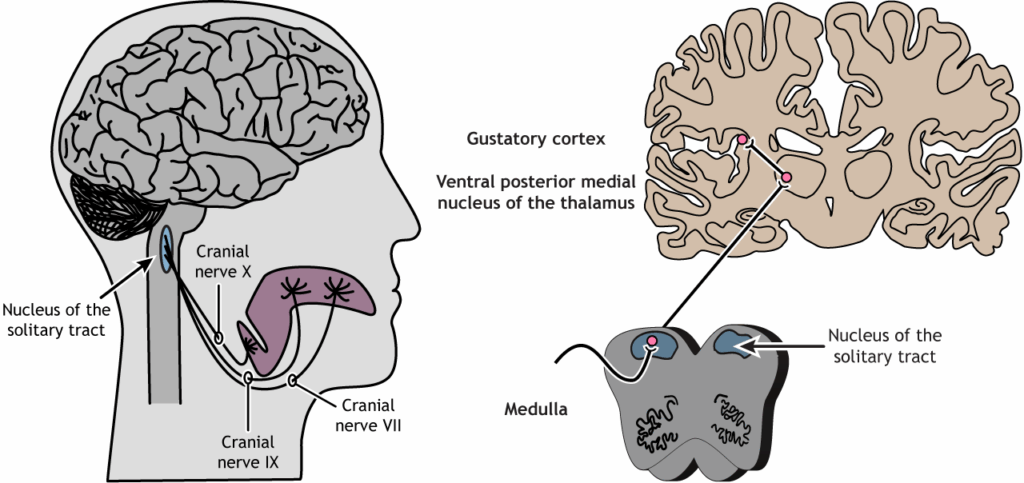
Taste’s multi-nerve complexity is truly remarkable. Each of these cranial nerves carries other information into the brain, like touch, temperature and pain information from the mouth, teeth, jaw muscles, as well as information from the body, like how stretched is the stomach, what’s being processed in the intestines. When you dive into how taste information makes its way to the brain, it’s not surprising that our “taste” for foods is affected by our mood, by the time of day, by where we are and by who we’re with. We lose our appetite when the dinner conversation gets too graphic, or when we get angry or anxious.
Our “tastes” can also change with experience and over time. Remember as a kid when you hated mushrooms, or anything other than mac and cheese? As you grow up, the sensitivity of your taste receptors changes- some get more sensitive, some less. We begin to prefer less sweet or more umami. As we try different foods, we learn that different flavors might be “tasty” rather than gag-worthy.
We associate certain times of year and different physiological states with different foods. You might be fine with a hot stew in winter, but turn your nose up at it in mid-summer. Some of these seasonal associations make biological sense. For example, craving crisp apples in October, when apples are ripe on the trees. The food industry uses science and psychology to market foods, taking advantage of how our taste systems are wired. The “mouth feel” of foods, the associations of foods with social occasions, are big business. How come I particularly want a Peppermint Mocha from Starbucks during the Christmas season? Or feel an urge to buy popcorn at the movie theater?
You get the idea that there’s a lot more to taste than what’s on the tip of the tongue.
This newsletter is devoted to explaining how biology works and how it is relevant to our daily lives. Most of us stopped learning about biology in high school or even middle school. And the way we learned it was as isolated concepts and vocabulary to memorize. I hope that this newsletter helps you rekindle that love of biology and might even help with better understanding of some of the important biology all around us. Please share this with anyone you think might want to take a look.
Thanks for reading!