One of the things I’ve noticed about any news having to do with wildlife or biology is that it is usually simplistic. The soundbites and headlines read something like, “Save the Polar Bears from Extinction,” “No Mow May will save the Bees,” “No Mow May Has Downsides,” “Insects are in Catastrophic Decline,” “Mosquitoes are Expanding their Range.” One week you learn that you should do everything possible to save honey bees or we risk no food for humans and the next we learn that efforts to save honey bees are endangering other insects. It’s no wonder that most people decide that scientists are incompetent alarmists or that no one has any idea whether to worry or just ignore all the messages. It’s crucial, though, that the media reporting on science not treat science topics like little TikTok videos with a one-size fits all answer. We can’t simply read the headline and assume that we understand everything we need to and that the idea/concept/discovery is it. Understanding how organisms interact in their ecosystem as well as how they are affected by human activity is complicated and conditions change and our understanding gets deeper the more we investigate.
Life is complicated. It certainly doesn’t fit into the 24-7 news cycle of short yes/no, black/white soundbites. Many of the headlines reporting on science can be both true and misleading at the same time. Each report is but a single frame in a long documentary with twists and turns. Some of the plot twists are well known and understood but the news article just doesn’t reveal them (likely because it would take too many words and many of us would just stop reading). Many plot twists are mysterious and unfolding as new information is discovered, and new understandings are reached by careful and persistent scientists with open minds. Not to mention that life changes over time, all the time. So, what’s true in the first instance may no longer be the case in a few years, as we learn more and as conditions change.
_________________________________________________________________
Take honey bees. Alarm bells are ringing about the rapid and alarming decline of honey bees world wide that was first reported in the early 2000’s, as a result of the multiple assaults on all insects. Honey bees are not immune to the global drowning of our farms, gardens and lawns in insecticides, herbicides and synthetic fertilizers. The alarm is real and the danger is present. Ask any beekeeper.
I sifted through the scientific literature about honey bee colony collapse disorder and the decline of domesticated, or managed, honey bees (the bees that commercial beekeepers and backyard beekeepers keep). Here is a rough progression of the process of trying to understand the possible cause(s) of the decline of honey bees. First of all, the reports and the science didn’t start coming out until the early 2000’s, about 10 years after the introduction of neonicotinoid pesticides and of the use of pesticide/herbicide and insecticide-coated seeds for corn, wheat, soy and cotton. It takes a while for people to begin to notice harm resulting from human activity, and it takes a while for scientists to get funding for a project, carry out that project and publish it. It doesn’t help that the big agrochemical companies actively work to prevent the studies and the information from getting out.
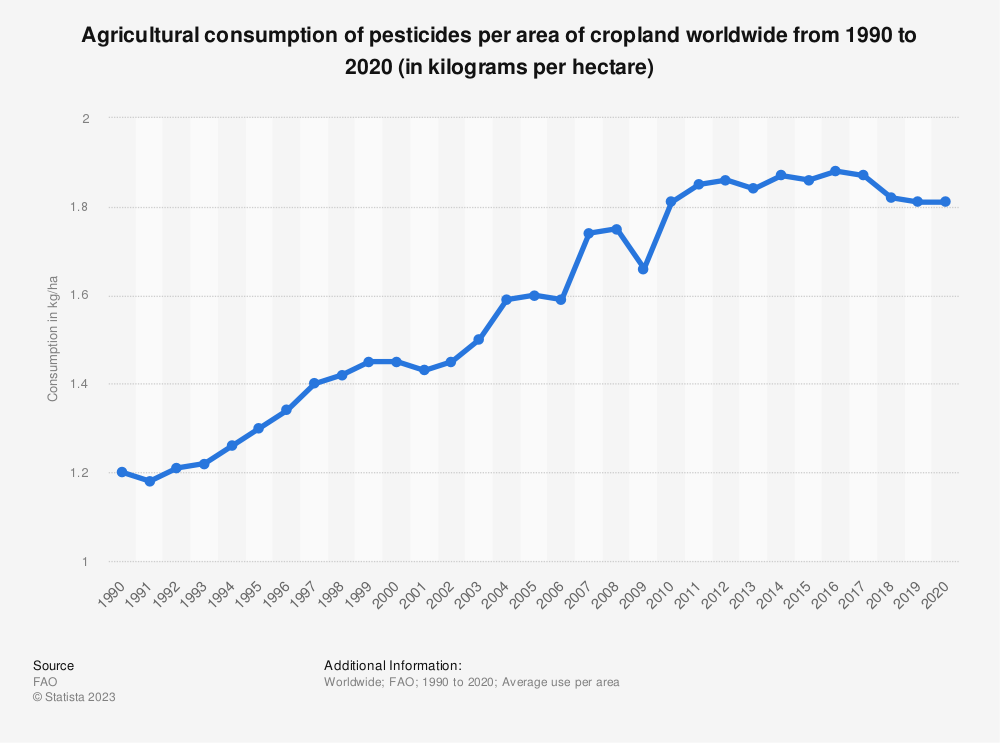
In 2006-7, after reports from Pennsylvania beekeepers of heavy winter losses of hives compared to 25 years prior, commercial beekeepers and hobbyists suspected that perhaps habitat loss (that due to human clearing land for monoculture agriculture or residential areas) led to hive starvation during the winter. Other thoughts were mite infestations or perhaps a virus. A number of scientific studies supported the ideas of virus or mite infestations, leading (unfortunately) to some initiatives among agricultural groups and local governments to treat commercial hives with pesticides to try to kill the mites. Of course, that backfired, and newer studies suggested perhaps the cause was viral infections, or “entombed pollen,” which is pollen that lacks the microbial agents that honeybees treat pollen with to keep it pest-free. There was virtually no mention of pesticides, but that doesn’t mean they weren’t involved. The massive escalation in pesticide use and the new technologies for delivering those pesticides were still pretty new to the scene. The graph below shows the increased use on a global scale.
Then in 2009-2014, more and more studies pointed the finger at pesticides. Pesticides, including fungicides, herbicides and neonicotinoid insecticides, singly and in combination, were strongly correlated with hive loss. Other ideas being studied included nutritional loss from habitat destruction. It turns out that honey bees, like people and other animals, are not really healthy if they are fed a monoculture diet. Variety is important for health. Studies linking the “high intensity,” industrial agricultural methods (which includes pesticides, of course) and honey bee loss were published. Others focused their attention on parasite infestations, or faster/premature aging, and immune compromise. By 2015, it seemed that scientists were coalescing on the likelihood that multiple stressors (pesticides, land use/nutritional, new viruses, parasites) were likely at fault. These conclusions, of course, allowed big chemical to shrug and say, “See, you can’t say that our pesticides are the reason- there could be any number of causes, so we will keep spraying.”
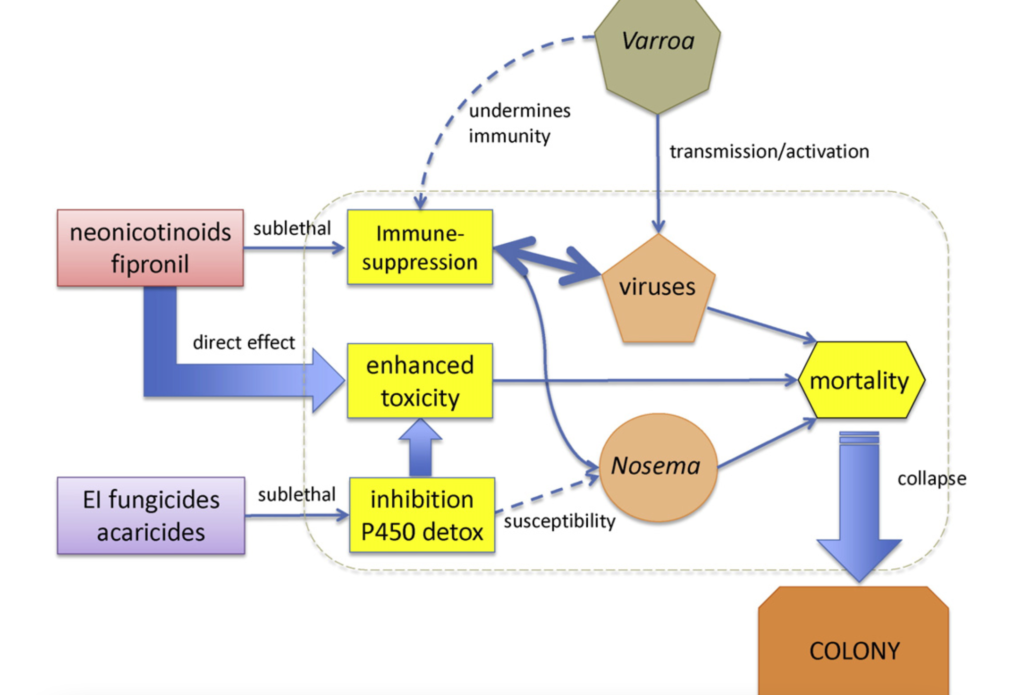
In 2016, an influential article written by Dr. Sanchez-Bayo and colleagues from Australia, the United Kingdom, Italy, Japan and France, synthesized over a decade of studies and convincingly demonstrated that low-level pesticides are the root cause of honey bee loss (Sanchez-Bayo, Francisco. “Are Bee Diseases Linked to Pesticides? – A Brief Review.” Environment international 89-90 (2016): 7–11). Pesticide exposure can directly kill foraging bees, or disable them and make it difficult for them to return to the hive. Pesticides in the hive cause disability, reduced hatching and loss of queen bee functioning. Herbicides reduce the flowering plants and variety of plants that bees can feed on, reducing their nutritional health, as well as bringing the toxins into the hive. The remaining bees are less healthy and so are immune-compromised and more susceptible to viral and other infections and diseases. Pesticides are the culprit of the dramatic and rapid decline of honeybees. Here’s an image from that paper that shows how pesticides interact with other types of stressors to make the outcome worse:
Meanwhile, most news articles that focus on honey bees are concerned with the human food supply- almonds, apples, oranges. 75% of our food relies on pollination, about 35% on honey bee pollination particularly. Most of the articles report one study at a time and one particular result, giving the impression that the scientists just can’t come to consensus, because, of course multiple scientific studies are working on different aspects of the same problem. Another complication in interpreting the science is that studies of commercial or household bee colonies are difficult because beekeepers often replace colonies whenever they are concerned. Here’s a figure from the Bee Informed Partnership that keeps track of colony loss. Doesn’t look like a catastrophic loss, does it? It seems to go up and down. Confusing, huh?
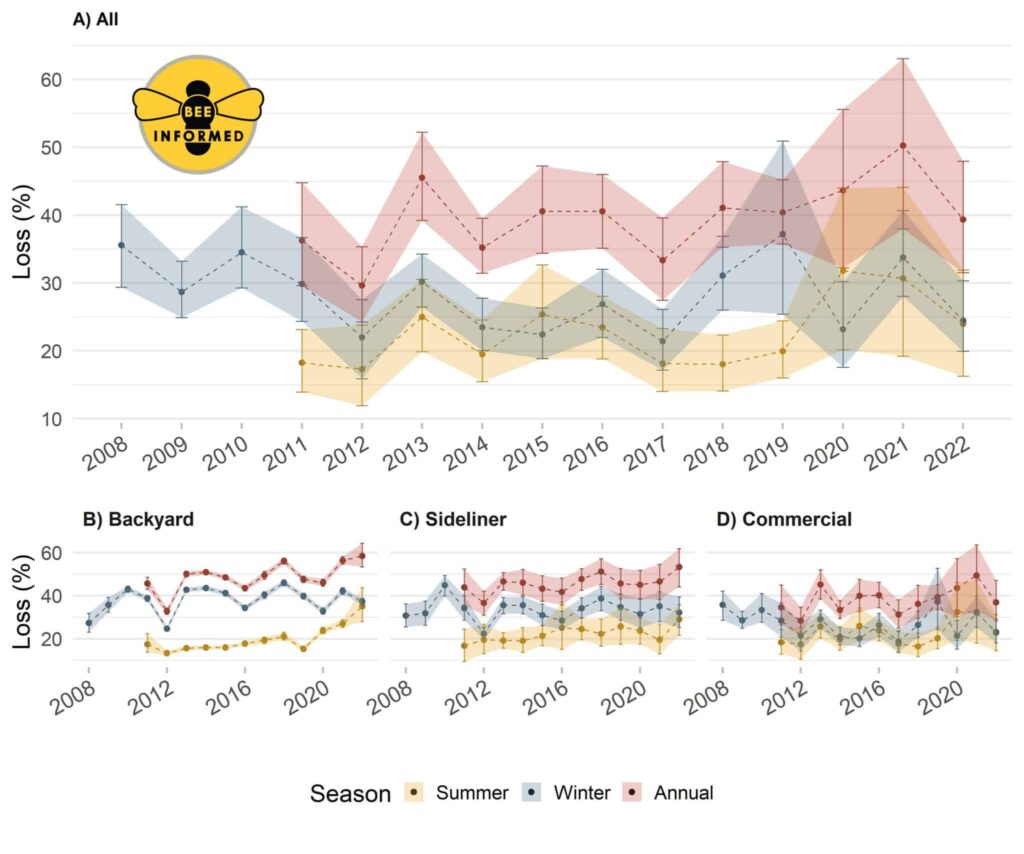
The loss rates overall are pretty high (40-60%) and, you’ll notice, we don’t have data before 2008, and the huge declines and alarm bells began ringing in the early 2000’s. So, basically, we’re looking (in the graph above) at the year by year changes during an overall situation with large colony losses. So, these numbers can be misleading, if not carefully explained. According to the USDA, there were 5 million “managed” colonies in the 1940’s and about half that amount today (despite an enormous expansion of US agriculture). In recent years, there has been an increased demand for commercial honey bees, due in part to the increase in almond production for “milk” and many other products, so beekeepers have been increasing the number of colonies, which will mask losses due to colony collapse disorder.
The big agrochemical companies love to capitalize on all this “confusion” to vindicate their own claims that a particular pesticide they are marketing is safe and essential for the human food supply. In addition, when one pesticide gets banned, another takes its place, so the situation is continually changing. Scientists are perpetually scrambling to keep up with the new toxins spewed forth by the agrochemical companies.
Scientists continue to publish studies measuring pesticide levels and hive losses across the globe and the role of multiple pesticides in pollinator and, indeed all insect, collapse is indisputable. The alarm is legit. Multiple stressors are involved, but pesticides are a key culprit in the recent collapse of insect-dependent ecosystem function. Remove pesticides and the bees likely can withstand the other stressors. A no-brainer solution that’s been muddied by the way that media report on science and the misinformation campaigns of big chemical companies.
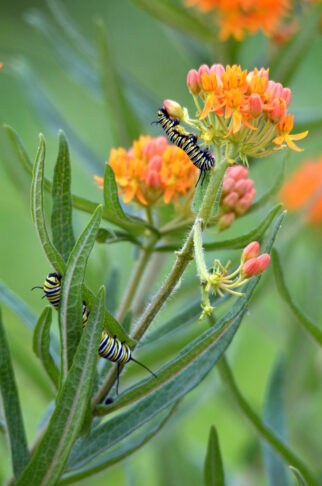
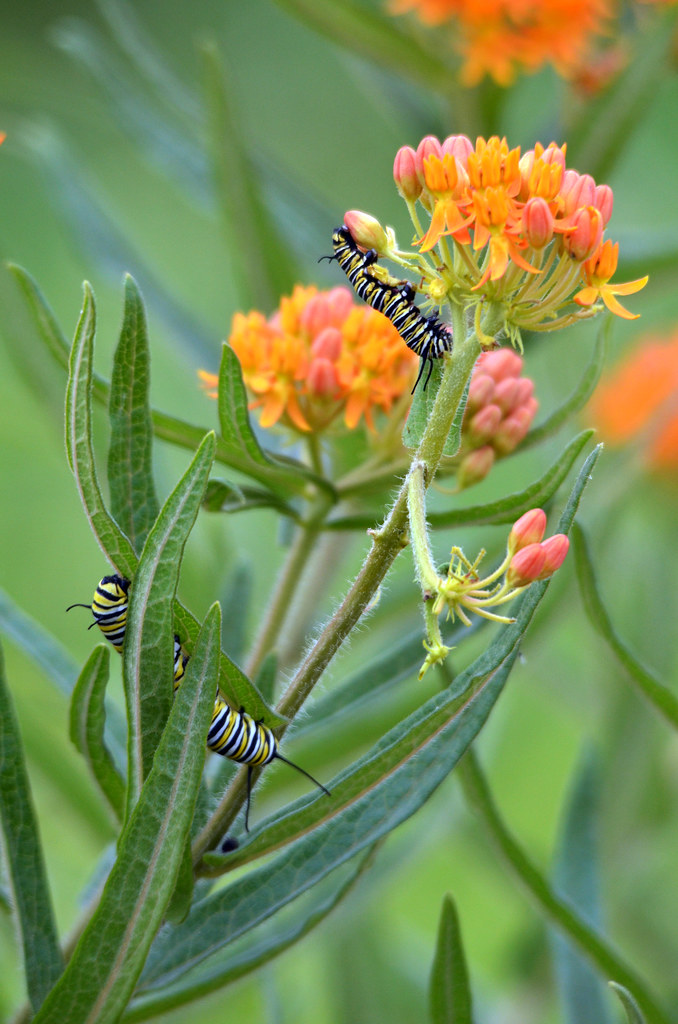
At the same time, honey bees are not the only pollinators– not by a long shot. Each region, area, ecosystem, has other bees, wasps, insects, birds, bats and other organisms that are crucial for pollinating flowering plants, from trees to ground cover plants. These native pollinators are not the flashy, domesticated honey bee that decorates all the garden signs and jewelry. These helpful insects and others live in different ecosystems and have evolved to feed on (and pollinate) the particular plants of an ecosystem. For example, Monarch butterfly caterpillars feed exclusively on native milkweed.
A quick glance at the scientific literature shows more than 2000 reports of declines in other pollinators, beginning in 1987. Losses of bat pollinators, bird pollinators, and insect pollinators that are linked to the loss of key plants, habitat loss, climate change, pesticide use, invasive species (which most of the time cannot be food for these pollinators), and harmful land use practices. In 2001, an important paper published by Drs. Cane and Tepedino from Utah State University, noted the importance of monitoring non-honey bee pollinators to protect North America’s non-agricultural plant pollination that is crucial for ecosystem survival. As more and more land is converted for human use: agriculture, suburbs, resource extraction of various types, habitat destruction, loss of native foods- we are seeing the loss of entire food webs, and insects and other animals are disappearing at alarming rates. Of course, the situation has only gotten worse since 2001. People who care are desperate for any kind of way to rouse concern and action.
For example, initiatives like No Mow May, Leave the Leaves, Pollinator Pathways and many others, are trying to reach the homeowners in suburban and urban communities, where the bulk of the land grab has been happening over the past 20 years. Most of these initiatives are only loosely based on specific science, but rather use sound bites and catchy icons and phrases to try to garner support. Most homeowners simply aren’t thinking that their little plot of land is part of a nature that is hurting. In fact, the monoculture grass lawn brainwashing has accelerated the idea that our yards can be “outdoor living spaces,” to be carefully tended to show the world what great homeowners you are. Most folks are unaware of any way of showing that care and neighborhood status other than chemicals, mowing and blowing and planting non-native, showy flowers that insects shun.
Our choice: Garden of Eden? or Toxic Wasteland?
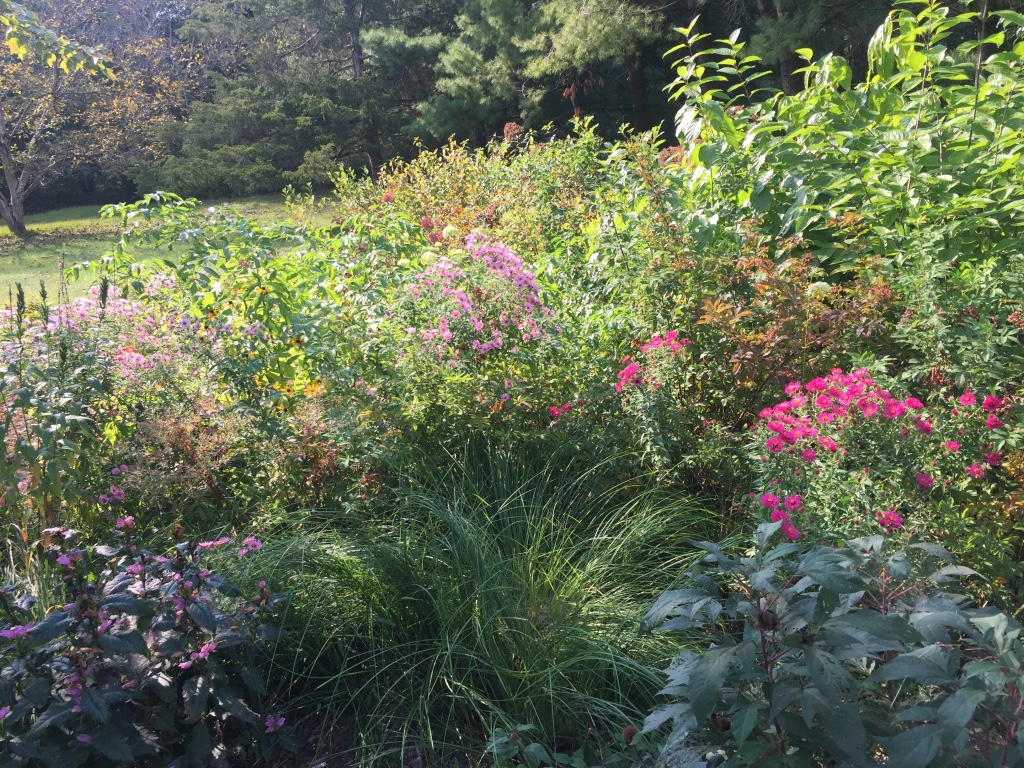
Garden of Eden ?
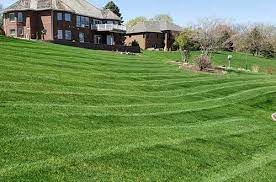
Toxic Lawn
In the end, it’s not at all complicated. We are invading and conquering Nature to such a degree that all organisms are suffering. Trying to find one root cause is way too simplistic. We need, rather, to change the way we interact with the non-human world. We are part of the Earth, we should care for it, not dominate. We need to stop the genocide of organisms with chemical weapons, stop the clearing of land and replacement with monoculture lawns, crops and asphalt. We need to provide space and habitat for the non-humans we need to share the Earth with, for our own survival.